
Designing and Building on Difficult Sites
Some of the most challenging residential projects are located on sites that initially appear ordinary.
In urban areas like Somerville and Cambridge, many remaining opportunities for housing involve constrained lots, aging infrastructure, high groundwater conditions, zoning limitations, limited site access, or existing neighborhood patterns that require careful response. These projects often demand coordination across architecture, engineering, permitting, and construction from the earliest stages of design.
On complex sites, decisions rarely exist in isolation.
Foundation design affects waterproofing strategy. Structural systems affect floor heights and massing. Drainage conditions influence excavation methods, scheduling, and long-term durability. Budget limitations shape material choices and sequencing. In many projects, these issues are addressed separately and at different stages, which can create conflicts once construction begins.
An integrated design and construction process allows these systems to be evaluated together while the project is still developing.
At Group Design Build, design and construction teams work concurrently throughout the process so that site conditions, detailing, cost considerations, and construction logistics can inform architectural decisions early rather than later in the field.
This approach becomes particularly important on urban infill projects where tolerances are smaller and site conditions are less forgiving.
Case Study: Union Legacy, Somerville MA
Union Legacy is a two-family residence completed in Somerville in 2024 on a former commercial lot within a dense residential neighborhood.
One of the project’s central challenges was groundwater. The site presented a high water table while also requiring a finished lower level, making below-grade durability and waterproofing critical to the long-term performance of the building. Conditions like these affect nearly every aspect of construction below grade, including excavation, drainage, structural design, insulation strategy, sequencing, and waterproofing assemblies.
Rather than treating these issues independently, the project approached them as interconnected systems from the beginning of design.
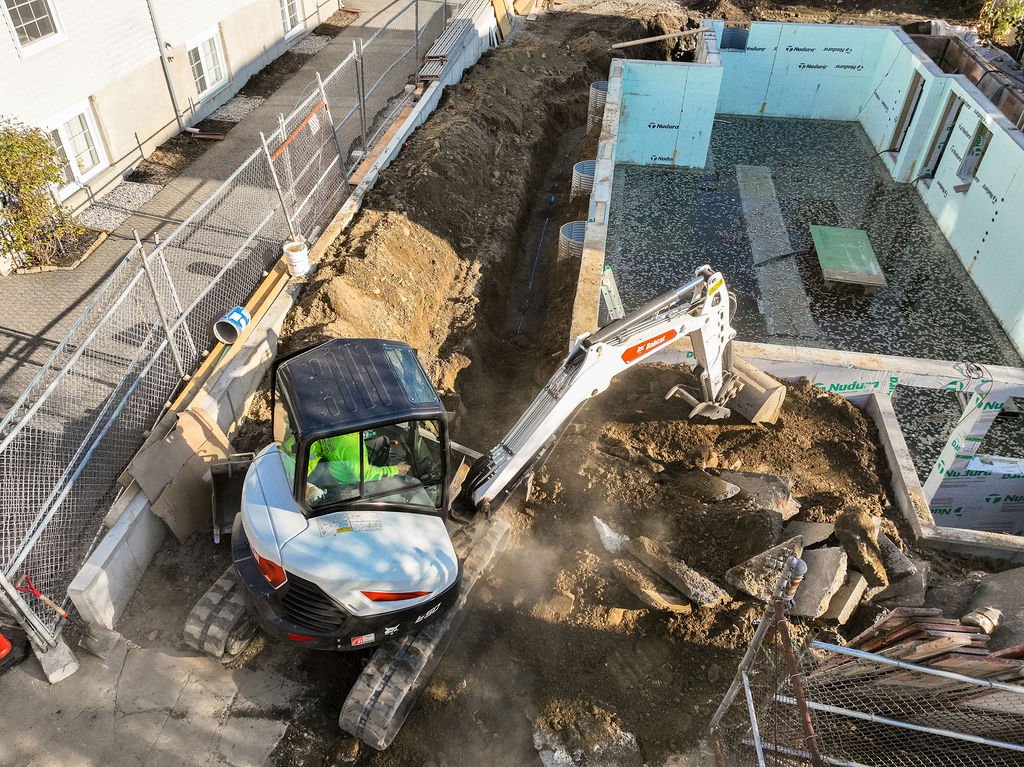
High water table prior to drainage and waterproofing systems.
The foundation system, waterproofing details, drainage strategy, and construction sequencing were developed together in coordination with structural and architectural requirements. The project ultimately utilized an insulated concrete form (ICF) foundation assembly, which provided both thermal performance and a more robust below-grade construction system under difficult groundwater conditions.
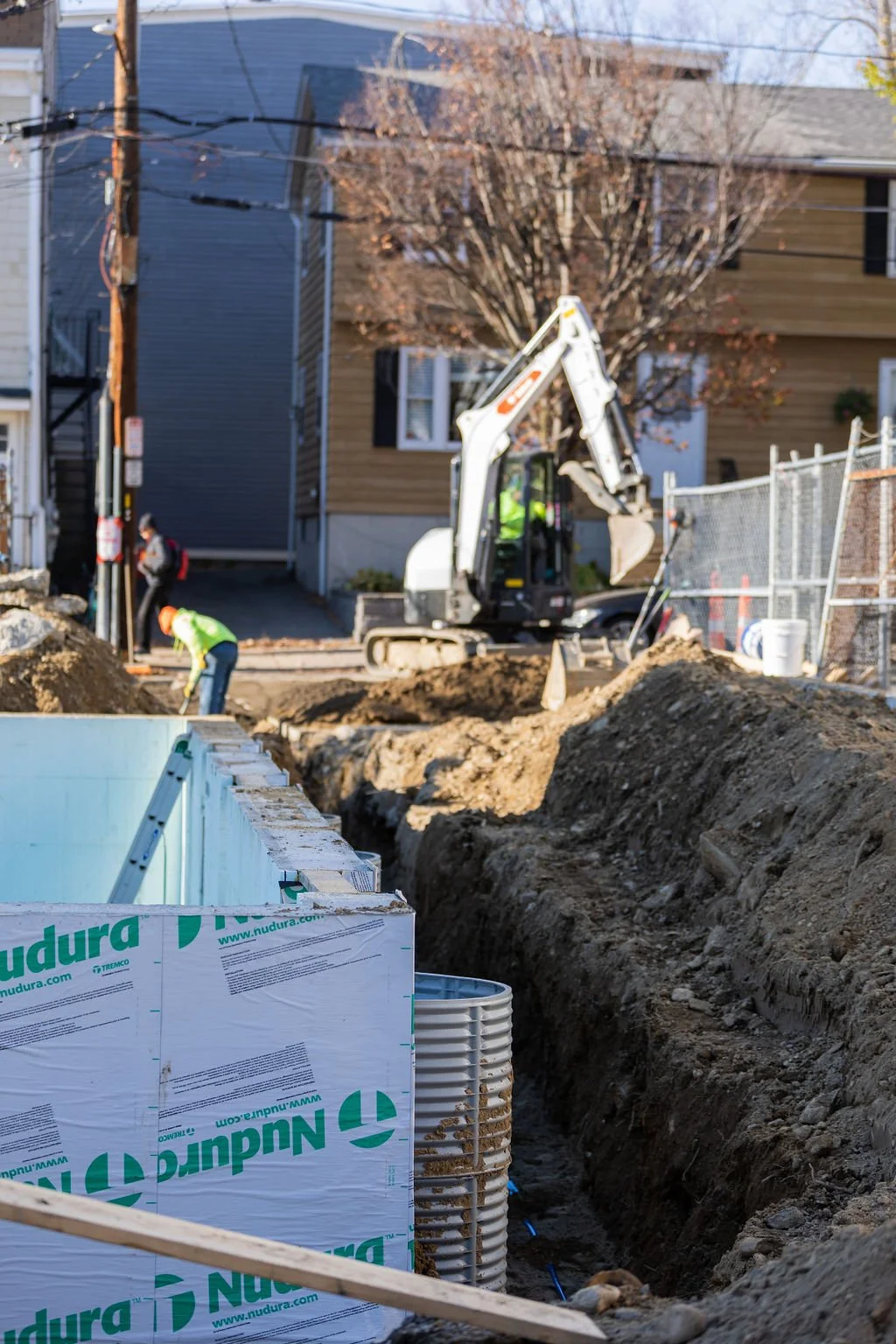
We prefer ICF foundations (Insulated Concrete Form) because it simplifies construction while improving thermal performance and waterproofing.
At the same time, the project also had important neighborhood and urban design considerations.
Although the building functions as a two-family residence, one of the design goals was to maintain the visual scale and presence of a single-family home within the surrounding streetscape. The site sits within a residential context where massing, proportions, and façade organization contribute significantly to how new construction is perceived within the neighborhood.
Achieving that required careful coordination between zoning constraints, structural systems, floor assemblies, and exterior form. Window placement, roof geometry, and the organization of the façade were all developed with attention to maintaining a consistent neighborhood scale while accommodating the program requirements of a two-family residence.
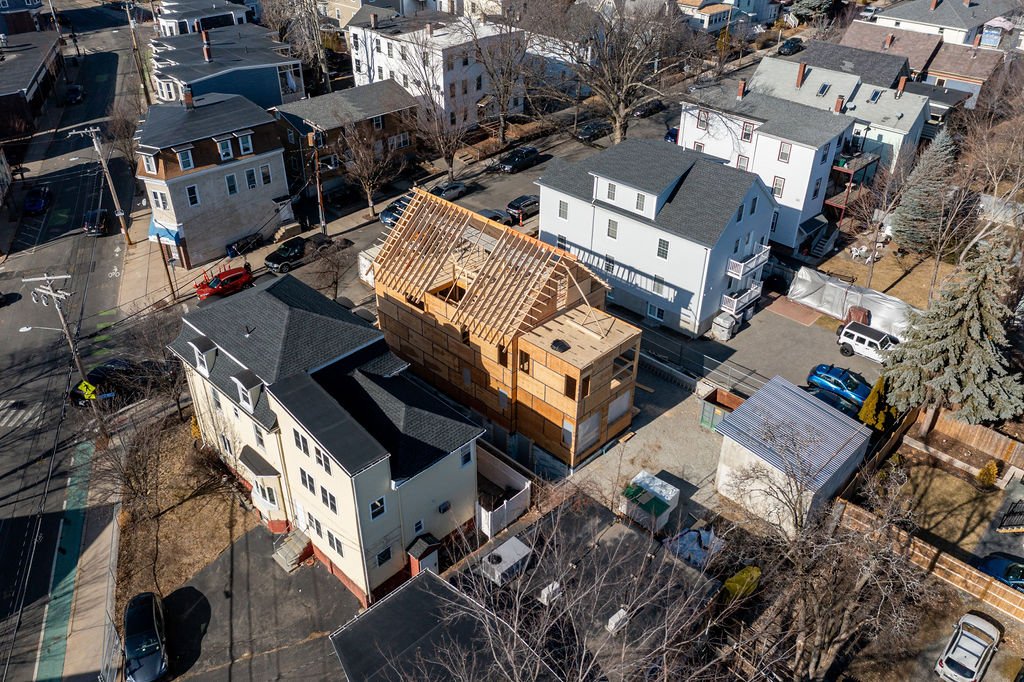
Rather than maximizing volume under zoning, the bones of the building integrate with the local vernacular.
Because construction considerations were integrated into the design process early, adjustments could be made continuously as site realities, detailing requirements, and cost implications became clearer.
Projects like this often depend less on singular design gestures than on the steady coordination of many small decisions. On constrained urban sites, issues such as groundwater management, excavation tolerances, utility coordination, waterproofing continuity, and sequencing can have long-term consequences if not carefully resolved during design.
An integrated process does not eliminate complexity, but it can make complexity more manageable by allowing technical, architectural, and construction-related decisions to evolve together rather than separately.
Building Within Existing Urban Conditions
Urban residential construction in New England continues to become more technically demanding. Sites are tighter, infrastructure conditions are often uncertain, environmental performance expectations are increasing, and projects frequently need to respond carefully to existing neighborhood patterns and scale.
These conditions place greater importance on coordination across disciplines early in the process.
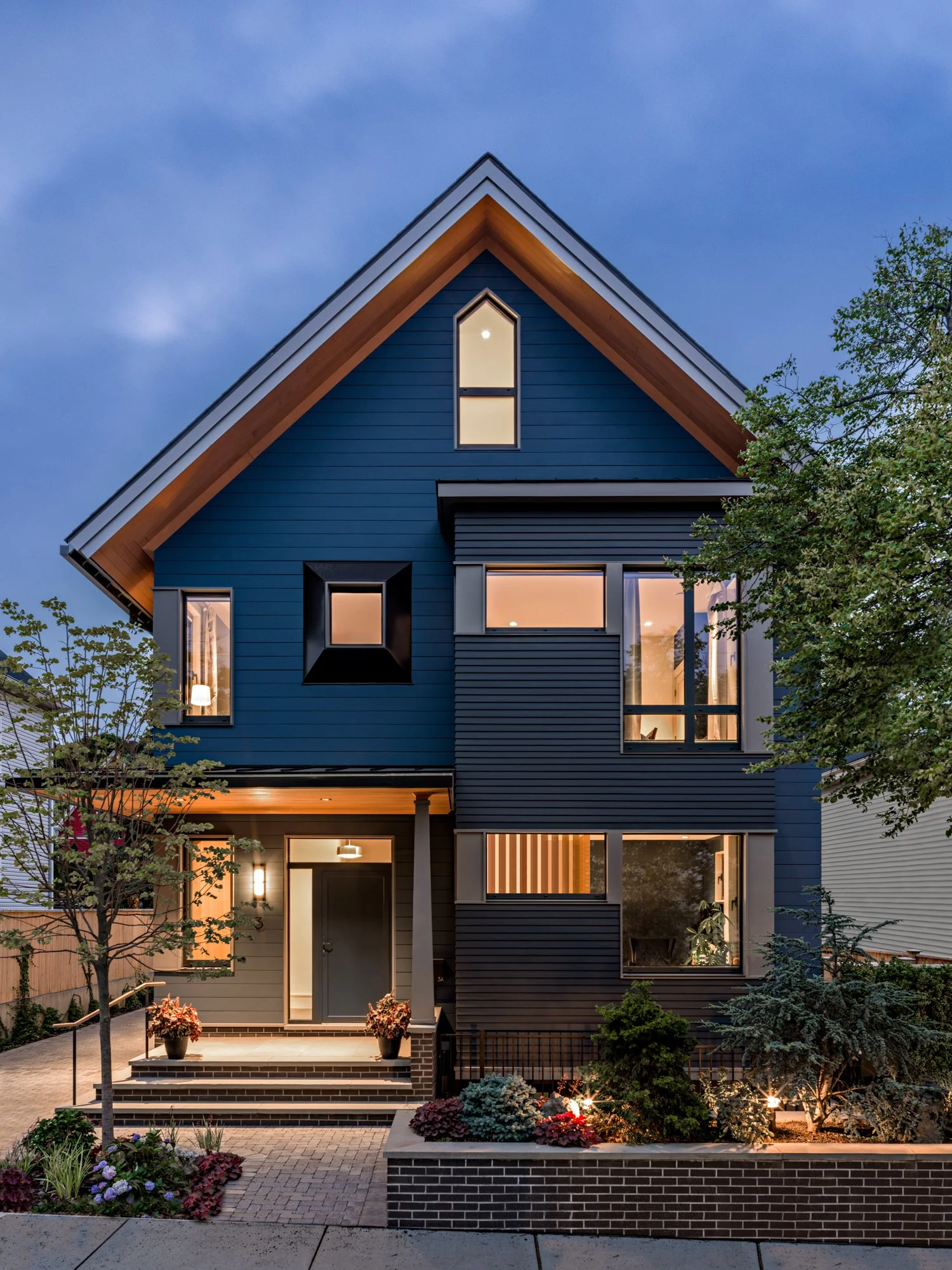
Street-facing façade integrating with classic Somerville vernacular while introducing a few contemporary details for passersby
Union Legacy reflects one example of how integrated design and construction can support that coordination. The completed building appears relatively restrained within its neighborhood context, but achieving that outcome required substantial attention to the technical conditions beneath and around the project.
In many cases, the simplicity of a finished building is the result of extensive coordination during the process of making it.
